• Beyond WealthTax Hashtaggery

    This is the type of two-sets-of-rules injustice that pisses people off. When people see evidence that those at the top don’t play by the same rules as everyone else, they get angry.

    What can we do, individually & with others, to fix the problem ASAP?

    Hero image from linked ProPublica story

    Image: Lisa Larson-Walker/ProPublica. Photos: Elon Musk (Tristar Media/Getty Images), Jeff Bezos (Mandel Ngan/AFP via Getty Images), Michael Bloomberg (Joshua Lott/AFP via Getty Images), Warren Buffett (Taylor Hill/FilmMagic/Getty Images)

  • The Way Forward Isn't Through the "Center"

    As long as big donors hold sway, bipartisanship won’t save us.

    Young FDR at a desk

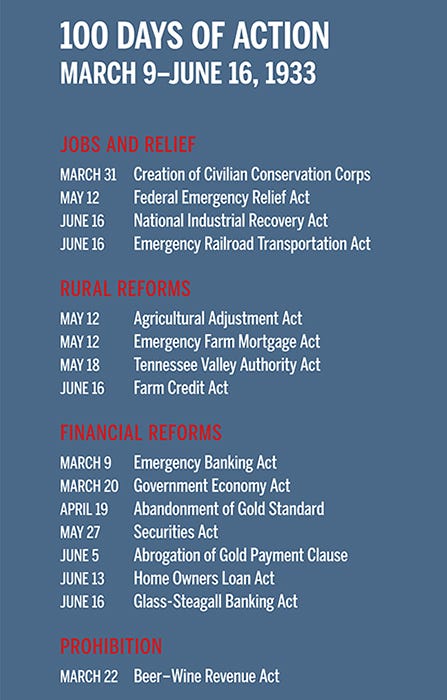
    There’s a reason that the new administration has encouraged comparisons with FDR. The Great Depression is the best analog we have to our current crisis cluster. Much like the 1930s, we kicked too many cans down the road, and they all landed in the 2020s. But a comparison of Biden’s first 100 days with FDR’s suggests that JRB’s legacy will likely be fleeting. Behind the headline trillions, the vast majority of spending is intended to be one-time only or to sunset. This administration isn’t creating structural or permanent changes like separating commercial and investment banking through the Glass-Steagall Banking Act. There are no guaranteed jobs programs like the Civilian Conservation Corps.

    List of FDR's 1st 100 days accomplishments
    Oh look, Glass-Steagall. How quaint!


    In other words, we’re turning on the money spigot, but only because these are extenuating circumstances. And only certain people may connect directly to the cash tap. As of now, there is no minimum wage hike, student debt cancellation, or public healthcare option, nor many other measures with widespread popular support, despite repeated campaign mentions of those very things.

    Since the covid vaccine announcement, the allure of “back to normal” has been irresistible. We’re largely settling back into pre-pandemic mode, conducting the same type of business and using the same metrics to determine success. However, if we want to truly fix the problems that the pandemic revealed, we can’t just sprinkle civility dust and infrastructure dollars over everything and call it good. Too many people live precariously for that to be sufficient; 43% of Americans couldn’t cover an unexpected $400 expense in cash before the pandemic.

    So we need FDR-like big structural change. We need economic justice. And we need to stop pretending that our current political duopoly will ever deliver them.

    Centrism Doesn’t Help the 99%

    Centrism, defined as some midpoint between the political left and right, seems like a natural spot to look for solutions. To prevent the pendulum from swinging too far one way, the thinking goes, we need to either vote more of the other side in, or include more moderate voices in the discourse and debates. Centrists are also great believers in compromise. But negotiating the middle ground between two parties that represent rich and corporate donors first and foremost has only made things worse for the mass of American people (e.g. Obama’s “Grand Bargain”).

    Last fall, the Rand Corporation found that the top U.S. earners have seen their incomes rise ~300% since 1975. Unfortunately, wages were basically stagnant for everyone else, stiffing the bottom 90% on $47 trillion dollars. The report has ugly parallels worldwide.

    Workers everywhere know they’re getting shafted. Regardless of who’s been in office, they’ve been on the losing side. The winners caused the 2008 financial crisis and fomented Occupy Wall Street, but then failed to fix the problems that caused those events. The winners back the established political parties, which have let them make the rules for a long time. Whether it’s the top 1% or top 10%, the people at the top—the winners—have had a functioning representative democracy. The rest of us are just told to shut up and vote for one of their two options, because it’s the lesser of two evils.

    There are advocates of centrist parties. The more parties, the merrier. No one should suppress alternative parties. We need more than two. It’s impossible to thread a needle through the current divide, and the duopoly simply isn’t getting the job done. On purpose.

    Two Parties Pushing People Away

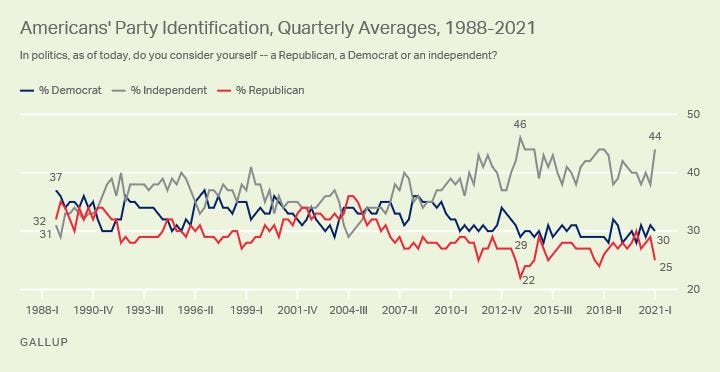
    From https://news.gallup.com/poll/343976/quarterly-gap-party-affiliation-largest-2012.aspx. The percentage of people identifying as independent is at an all-time high.

    Our elected officials are incentivized to raise money by vilifying the opposition above all else. It’s Red vs. Blue ad infinitum. 2024 will likely see $20 billion spent on two messages:

    “But Trumpism!”
    ”But Socialism!”

    $20 billion was the price of ending homelessness according to a 2012 HUD estimate.

    The polls tell us that Americans want elected officials to work together to advance the public interest. Based on their absolute resistance to making permanent changes that help actual people, elected officials recognize that advancing the public interest won’t get them paid. Keeping big donors happy will.

    The Way Forward

    Fixing our effectively corrupted politics will require many reforms. The electoral college, plurality voting, gerrymandering, corporate capture, and above all, the unresponsive duopoly of Democrats and Republicans must all be broken.

    The recent announcement of a splinter GOP faction suggests a way to make it happen. While Democratic party reformers are working on a generational plan to elect more progressives, these potential breakaways want faster results, either by voting as a unified bloc within the Republican party or by forming a new one.

    If the product of this movement is still corporate-backed, which it likely will be, then nothing will fundamentally change. But it suggests the formation of new parties is viable for the first time in living memory. 2024 could see four major parties vie for the White House: A populist party on the right, a new center-right party, the center-right Democrats, and a new populist party on the left. That’s what happened in Spain in 2015, with Ciudadanos (Citizens) on the right and Podemos (We Can) on the left.

    Should a new populist party on the left foreswear corporate cash, inoculating it against corporate capture, it would have an instant advantage over all others. It could sweep into power for a generation and enact a new New Deal.

    Representative government is a good invention. It lets us elect advocates who can fix problems and manage day-to-day civic operations. Unfortunately, large donors have turned our system into a money-making machine for themselves at the expense of everyone else. If we want to fix ::all this::, we’ll have to do it ourselves. We’ll need to create those viable new parties. We’ll need to volunteer. We’ll need brave, capable people to run for office at every level. When they get there, we’ll need progressives old and new alike to caucus together. And we’ll need to keep doing all of it until we get big structural changes.

    Edited by Dan Luft

  • Civil Unrest Is Here to Stay

    Economic violence has made the USA a tinderbox. Cops keep lighting matches.

    Chicago River bridges raised at night during civil unrest in 2020.

    We’re a few weeks shy of a year since George Floyd’s murder and the uprisings that followed. “Everyone saw it,” said one Trump-loving relative. But does everyone remember?

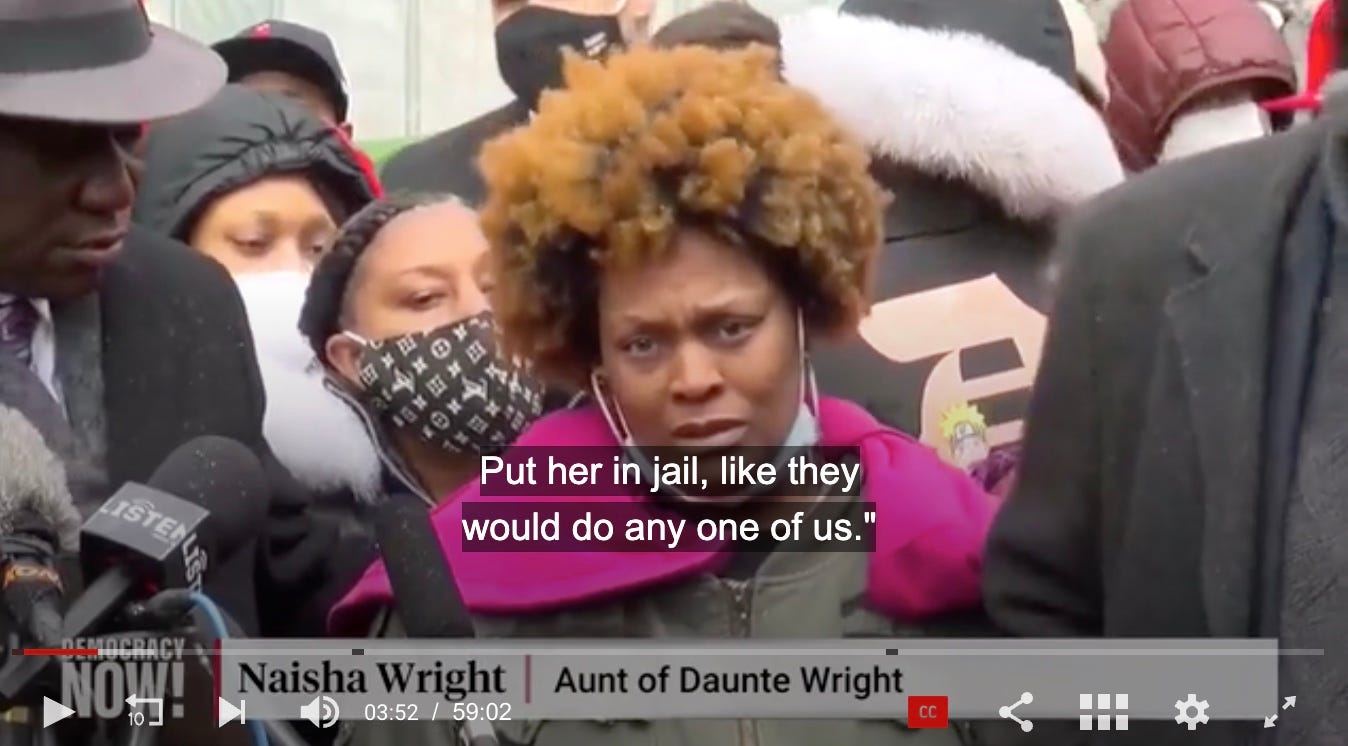
    There’s reason to doubt. This past week, we heard familiar calls for peace following the police killing of 20 year-old Daunte Wright. Pleas for restraint from elected officials ring hollow, however, when those officials resist fixing the underlying causes of civil unrest. Especially when they ignore protester demands and demonize them outright. These cynics put the burden of maintaining public order on rightfully outraged citizens instead of addressing the sources of their ire.

    The Spark: Violent Injustice

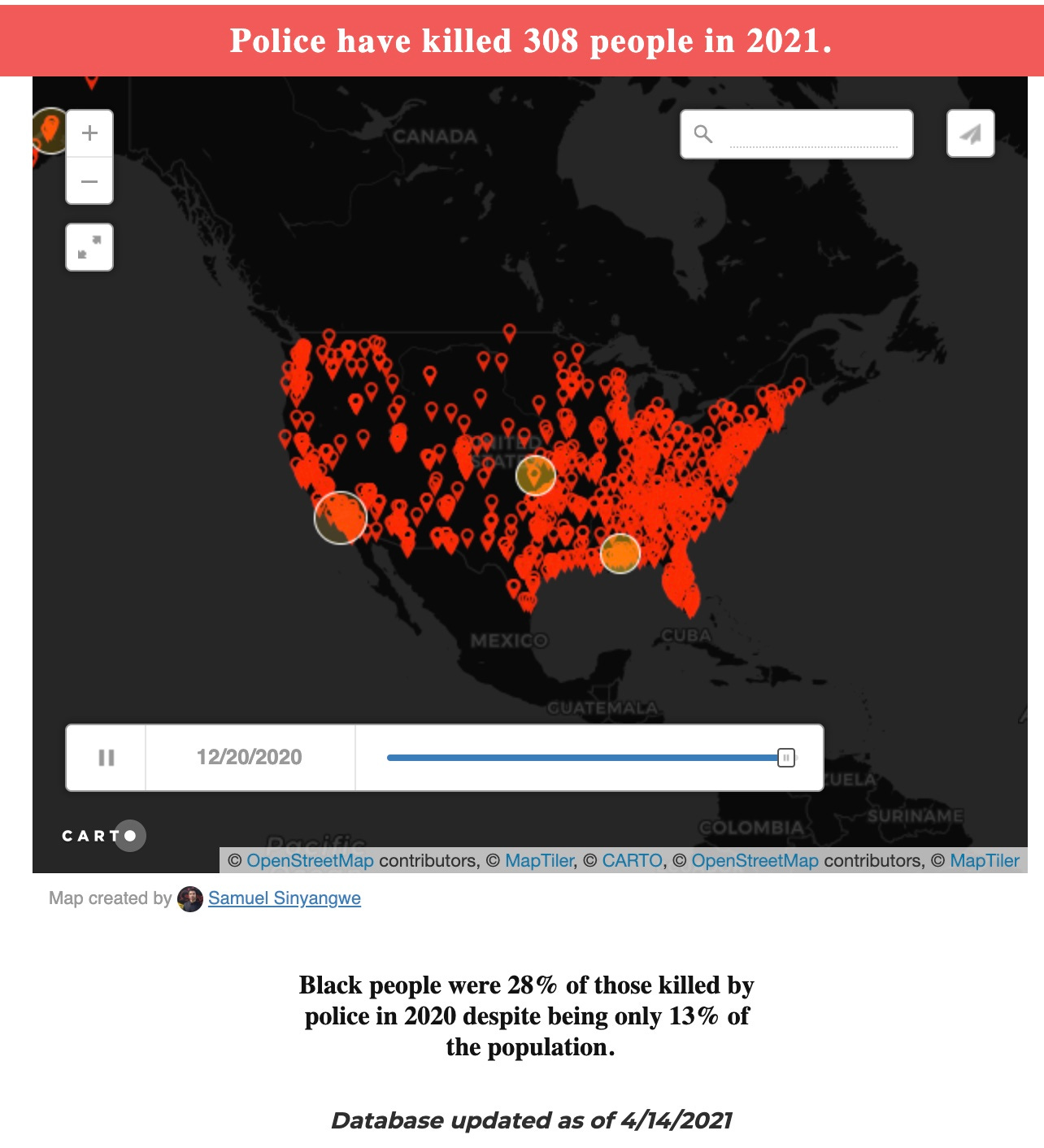
    Civil unrest is not new. It’s a chronic condition, and the US seems to be trapped in an endless cycle of it. Cops kill Black and Brown people, prompting outraged protests, which police use as an opportunity for more violence.

    "Police have killed 308 people in 2021 as of 4/14.
    From https://mappingpoliceviolence.org/


    The Tinder: Economic Violence

    Killer cops are just the spark. Income inequality and the resulting wealth gap are the tinder. These aren’t just pesky problems for economists. They create and worsen civil disorder worldwide. 250 million workers went on general strike and hunger strikes in India over the past year for economic reasons.

    Author and activist Kimberly Jones laid out the causes of civil unrest on Last Week Tonight with John Oliver last year. She described labor theft under 400 years of slavery, as well as mayhem and death at Tulsa and Rosewood—literal economic violence generations after 1865.

    The wealth destruction and extraction is hardly a distant memory, either. The Rand Corporation found last year that the top 10% have been extracting wealth from the bottom 90% since 1975. Fewer Americans have a material stake in the country every year. The resulting wealth gap is the stuff of revolution. Jared Ball, author of The Myth and Propaganda of Black Buying Power has quoted the very rich as saying, ”give working people some money, or they’re going to rebel.

    No Justice, No Peace.

    If we keep doing the same things, we’ll keep getting the same results.

    As for the spark, there are some voices on the side of reforming the institution of policing. But they’re outnumbered by those invested in militarism. Moreover, the police have proved impervious to reform over time. From the institution’s founding in the slave patrols to the “warrior cop” mentality to qualified immunity, they ain’t changin’. You can pass all the laws you want. In the moment, cops do not care about the law. They care about control and compliance.

    Abolitionists have been working on alternatives to our current policing system for decades. If we want to break out of this endless cycle, shouldn’t we hear them out?

    We can do something about the tinder, too. We could stop resisting incremental changes like minimum wage hikes, start restoring our social safety net, and give all Americans some economic skin in the game.

    Regardless, let’s do something. Until we fix the problems that cause it—sparks and tinder—civil unrest is here to stay.

    Edited by Dan Luft

  • Filibuster or No, S1 Has Rot Within

    The “For the People Act” contains poison pills meant to cement duopolistic power.

    As Georgia was passing a racist anti-voting rights bill last week, Senator Amy Klobuchar held hearings on Senate Bill 1 (S1). S1 had been passed by the House of Representatives as HR1; it’s also known as the For The People Act of 2021.

    S1 has overwhelming Democratic Party support. It’s being sold as a bold move against voter suppression and the greatest advancement in voting rights in generations. Newly-elected House progressive Mondaire Jones, Michelle Obama, and erstwhile Presidential candidate Lawrence Lessig all support the bill. So do public interest groups like Common Cause.

    Moreover, several prominent Republicans have decried the bill, including Mitch McConnell, which is enough for some Democrats to support it no questions asked. Rep. Claudia Tenney (NY-R) weighed in as well, saying that the bill “is focused on protecting House Democrats, not our sacred democratic principles.”

    Voter Registrar: "So what do you think the primary role of government should be?" Voter: "Owning the libs." Registrar: "You're a Republican. Just put your 'X' here."
    This is our politics under the duopoly: Endless cheap shots from both red & blue. [Doonesbury, 3/28/2021]

    It’s not just the GOP, though. Opposition parties (The Greens and the People’s Party) are highlighting the bill’s poison pills: New laws that would make it much more difficult for new parties to compete. You won’t find them mentioned in the Senate’s simple section-by-section guide to the bill, only in the full version. Even independent news viewers could be forgiven for not knowing about S1’s problems, since Democracy Now! has yet to mention them, much less MSNBC or CNN. But they’re there. The new sections would:

    • Increase the fundraising requirements for a party to qualify for public matching funds from $5,000 to $25,000 in 20 states.

    • Lock in a two-party plus independents structure for state redistricting. This would ultimately exclude small and new parties from participating on redistricting boards.

    • Do away with general election grants that have historically been accessed when a party wins 5 percent or more of the vote in the previous presidential election.

    Right now, national political party committees can’t give more than $5,000 to candidates. Section 5214* of the bill would raise that to $100 million. Political comedian Lee Camp’s reaction to that line is not safe for work, but it’s completely fitting for the news.


    S1 is not expected to pass the Senate unless it kills the filibuster first, but that’s beside the point: The anti-opposition party provisions need to be removed before the bill passes.

    Back to Harvard Law Professor and campaign finance reform advocate Lawrence Lessig. He has suggested that the For The People Act’s good parts are so important that the Green Party and others who object to its poison pill provisions should just shut up. Lessig dismisses the idea of removing the bad parts, saying that the bill will either be voted up or down as a practicality. Public pressure can change votes. Is he not even willing to try?

    At a time when the demand for a multi-party democracy is higher than ever, we can’t let the duopoly prevent it from happening if we ever want more than two viable electoral choices. Expanding voting rights while shrinking voting options makes no sense.

    *Section numbers refer to HR1 Version engrossed in House 3/3/2021

  • Spoiler or Scapegoat?

    How Democrats took the wrong lessons from 2000, never looked back, and are still paying the price.

    (L-R): Tim Russert, Tom Brokaw, and Katie Couric on Election Night 2000

    Conventional wisdom is stubborn. When information conflicts with our prior assumptions, we tend to reject it out of hand. Even when experts show us charts and data and give examples, some ideas just make us shake our heads. Economist Mark Blyth, author of Austerity: The History of a Dangerous Idea, has described giving fact-packed testimony about the federal deficit to dismissive members of Congress who refused to consider it on its face, and were even less likely to ponder or grapple with it over time.

    Something similar occurs when Ralph Nader is mentioned. Of the people who know his name, most have an opinion of his role in the 2000 U.S. presidential election. Many support the “spoiler” theory, saying that Al Gore would have bested George W. Bush had Nader not run. Many Democrats consider this assumption to be self-evident and long-settled at this point. Suggesting otherwise is fightin’ words. Yet the facts support a much different conclusion that casts the Democratic party in a harsher light. In this version, Democrats are betrayers of their stated ideals, beholden to big-dollar donations, and pitted against the working class that drove their heyday.

    What Nader Voters Actually Said

    Dems’ “Ralph Nader was a spoiler” narrative ignores what his voters actually said, and presumes that they would have voted for Gore had Nader not run. This is a zero-sum approach to the electorate. It assumes that people either vote or don’t, with very little change in the percentage of the population that do either over time. It erases the voices of those who feel disenfranchised by the duopoly.

    The NBC News team of Tom Brokaw, Katie Couric, and Tim Russert discussed the situation in front of the whole nation on election night 2000. Their exchange, as shown in the 2006 documentary An Unreasonable Man, lasts less than a minute. Brokaw suggests and Couric confirms that Nader voters wouldn’t have voted for either Bush or Gore. Russert notes immediately that Dems would be unlikely to accept that explanation, and would probably just accuse Nader of being a spoiler.

    They were all right.

    What Democrats Learned: Sue & Shame

    The 2000 election traumatized Democrats. In response, they could have looked honestly at their party platform and messaging. They could have listened to the electorate. They could have adopted some of the other parties’ platform planks, which was how the duopoly had neutralized previous threats.

    They did none of those things. Instead, they chose to attack the very idea of third parties, and Nader in particular. Since 2000, the Democratic party has used the courts to ensure it only has to deal with the GOP. Republicans got the message, too, and both halves of the duopoly now sue other parties regularly instead of (e.g.) adopting their ideas. Voters who reject the lesser of two evils are shamed outright: “But Republicans!”

    The ugly truth is that voters weren’t buying what Gore was selling. They weren’t that thrilled with Bush, either. But pinning 2000 on Nader kept Democrats from asking themselves the tough questions that would have prevented Trump. Like “What would get the 100 million non-voters to become loyal Democrats?”


    The thing is, the premise of Nader’s presidential run was and is correct: There are only a handful of issues that separate the duopoly, and both serve corporate donors more than they serve the mass of Americans. That’s proved truer over time.

    Democrats have betrayed their stated values for more than a generation. Bill Clinton ran as a populist! Then, as Bob Woodward noted in The Agenda, he turned right around and brought in “the experts”— Wall Streeters who pushed bond trader interests over economic policies that would have helped American people as a whole. Is it any wonder that twenty-plus years after Nader’s 2000 run, demand for a viable new political party is higher than ever?


    Still Paying the Price

    Ralph Nader isn’t about to stop speaking truth to power. In a recent appearance on the Bad Faith podcast, he scorned the current Democratic party as an arrogant bureaucracy that takes constituencies like labor unions for granted. Don’t worry, he torched Republicans too. In the process, he showed how Democrats are still paying the price for 2000.


    Of possible interest: I ran Ralph Nader’s campaigns. A political revolution is vital—and much harder than you think.

  • "Let's Give Biden a Year."

    Hard no. There will be no honeymoon.

    “The way the Democratic Party is run now—for quite a number of presidential cycles—is they pick a nominee in a kind of half-ass process that doesn’t really represent much of anybody. Then they tell everybody to just shut up. Don’t bring up anything that will complicate life for your nominee. You know he’s not for you on this. Why badger him? He’s not gonna be for you, for reasons that you don’t understand but are good reasons. Shut up. Turn off your brains.”

    — Journalist William Greider, in 2006


    “Don’t push Biden now. We’re trying to win an election. Do you want Trump to win?”

    “Don’t push Biden now. He’s not even in office yet.”

    I’m already hearing suggestions that the new president should be given at least a year of impunity before we dare suggest that his actions, planned actions, and timelines are insufficient to the multiple crises at hand. Apparently we skipped past “Don’t push Biden now, it hasn’t even been a hundred days yet.”

    Joe Biden has been a public figure for what, 50 years? Do we not have enough data to make an assessment yet? He got a pass in November because Trump. But Trump’s out, so now what?


    What makes anyone think we’re about to get the immediate, sustained New Deal-level spending needed to materially improve American lives as a whole? Biden loved dropping FDR’s initials on the campaign trail, but Democrats don’t even remember how the New Deal happened.

    Biden’s infrastructure and climate plan is supposed to be “orders of magnitude” larger than anything before. But will it truly deliver climate justice? Too many “recovery” packages have been bailouts for corporations and inequitable trickle-downs for everyone else. It’s angry-making.

    Senator Warnock’s “Want a $2,000 Check?” ad.

    Sending the $2K checks with alacrity would help, as would a $15/hr. minimum wage, UBI, and medicare for all. The CARES Act happened like a Thanos snap. That’s the urgency and pace required. If the administration doesn’t deliver change we can all feel soon, it’s going to be a long hot summer. As David Sirota put it recently, “the anger is gonna go somewhere.

    The measures above are just band-aids. We’ll also need to fix the big structural problems that demagogues use to divide us. Because if Trump doesn’t run again in 2024, a competent fascist will. And if Dems don’t deliver, and there’s not a viable new option, that’s who will be in the White House in January 2025.

    If anyone can push the Biden administration, now is definitely the time. There will be no honeymoon.

  • Short the Duopoly. Bet on Innovation.

    How 2024 could see a new political party sweep into power for a generation.

    Image by VectorStock 27759757


    Americans claim to prize innovation and choice. Our nation’s businesses are chest-thumpingly proud of the choices they create, both for the 330 million people here at home and for billions more around the world. U.S. businesses spend hundreds of billions on research & development every year to invent still more choices. Apple went on an R&D spending spree when it was 90 days from bankruptcy in 1997 and turned it all around.

    So why do we tolerate the stale offerings of a duopoly in our politics? The $16B industry of politics (<—watch this now) hasn’t changed substantially in 150 years. As Katherine Gehl and Michael Porter detail in The Politics Industry (2020), that’s by design. The industry benefits its dominant players, the Democrats and Republicans.

    Voters know they’re not getting their money’s worth. November exit polling by Fox (!) found widespread public support for government-run healthcare (70%), green and renewable energy (68%), and other policies. Yet the duopoly shows no real interest in voter preferences. Their real customers are large donors, including corporations. Between big-dollar donations and gerrymandering, Democrats and Republicans can largely ignore the electorate and still get paid.

    Opportunity for Political Entrepreneurs

    This resistance to big structural change has created an opportunity for political entrepreneurs. Last week’s Gallup poll story found that demand for a viable new political party is at a record high. Is it really inconceivable that some innovative upstart might supply it?

    FiveThirtyEight doesn’t think it will happen. In “Why a Trump-Led Third Party Is Unlikely“, the author recites the usual litany of reasons that a third party can’t win, and concludes that it’s unlikely. That conventional wisdom regarding new political parties misses something: The national mood. Notions of surface unity aside, people are angry, and have been for decades. That anger has surfaced as populism, and it’s not going away.

    The good news is that the R&D needed to turn populist anger into productive civic engagement has already been completed and is free at the point of use. Beyond new political parties, innovations like ranked-choice voting and direct democracy are a reality in a growing number of cities and states.

    Picturing a New Party’s Path to Power

    It’s tough to imagine someone without a D or an R next to their name in the White House, so let’s chart one potential path: An upstart party adopts a populist platform, foreswears corporate donations, and runs a few candidates for Congress next year. Lo and behold, one or more of them wins. The political firmament shakes. Some elected officials, frustrated with the limitations of their party’s agenda, change their affiliation to the new party. The new caucus now holds enough seats to swing votes, and it’s not even 2023 yet. The new party holds substantive, compelling conventions, debates, and presidential candidate primaries. By the time the presidential debates roll around, their candidate is polling at 15% or higher, qualifying them for the 2024 presidential debate.

    If a viable new party’s candidate gets on the debate stage in 2024, it’s over. The duopoly is unequipped to respond to a candidate whose agenda is driven by an issue-centered platform instead of political expedience.

    Turning Non-Voters Into Citizen Stakeholders

    The focus on voter preferences misses an additional critical element of the upcoming shift in power: Previously steadfast non-voters. Tens of millions of people don’t vote, mainly because they feel disenfranchised. Their lives don’t materially change regardless of who’s in office, so why should they care? If a new party turns the politically homeless into voters, it could be in power for a generation.

    Conventional wisdom salesmen will dismiss new parties until they win elections at the national level next year. Then they’ll really dismiss the upstarts in 2024. They’ll be wrong. Americans crave choice, they’re angry, and they’re tired of being told no.

    Of possible interest: Pick a Party. Any Party.